Postpartum Anxiety: Symptoms, Causes & Getting Help
Postpartum anxiety explained: difference from baby blues, symptoms, why it happens, and how to get treatment. You're not alone — and it's treatable. Get help today.
Eliana M
5/1/20264 min read
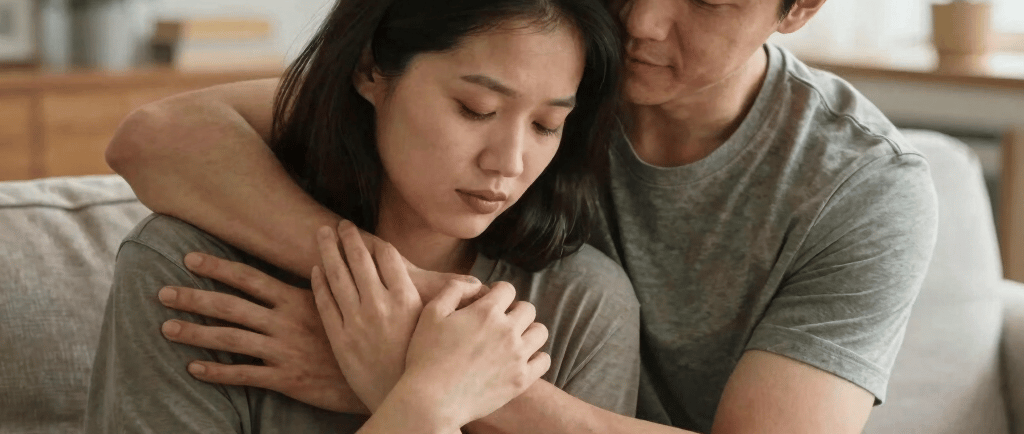

You had a baby. You should be happy. Everyone keeps saying you should be happy.
But instead, you're terrified.
Not the normal new-parent worry. Not "Is my baby breathing?" (though you're checking that too, obsessively).
This is different. This is: What if something terrible happens? What if I'm not capable? What if I hurt my baby? What if my baby gets sick and dies?
Your mind won't stop. You can't sleep even when the baby sleeps. You're checking on them constantly. You're googling symptoms for diseases that are incredibly rare. You can't eat. You can't focus. You feel like you're going insane.
And everyone around you keeps saying, "Oh, you have the baby blues. It'll pass. You're just tired."
But this doesn't feel like tiredness. This feels like something is seriously wrong with you.
You might have postpartum anxiety. And you're not alone — and it's not your fault.
The Difference (And Why It Matters)
Baby Blues:
Starts 3-5 days after birth
Includes crying, mood swings, irritability
Lasts 1-2 weeks
Goes away on its own
You still feel like yourself (just emotional)
Postpartum Anxiety:
Starts anytime in the first year (often 2-4 weeks postpartum)
Includes intrusive thoughts, racing mind, panic
Lasts weeks to months without treatment
Doesn't go away on its own
You feel like a completely different person
Postpartum Depression:
Starts anytime in first year
Includes deep sadness, hopelessness, numbness
You don't care about things you usually care about
You feel empty
Lasts weeks to months without treatment
Here's what's confusing: You can have baby blues AND anxiety. You can have anxiety AND depression. You can have one and not the other. And all of them are medical conditions — not character flaws.
What Postpartum Anxiety Actually Feels Like
(Not what movies or TV shows you)
The Thoughts:
Obsessive worry about your baby's health (even when they're fine)
Catastrophic thinking ("What if the car crashes and baby dies?")
Intrusive, unwanted thoughts that scare you
Racing thoughts you can't control
Checking on baby compulsively to make sure they're breathing
The Physical Sensations:
Racing heart
Difficulty sleeping (even when baby sleeps)
Nausea and loss of appetite
Dizziness or feeling detached from your body
Constant tension in your chest or throat
The Emotional State:
Feeling on edge 24/7
Irritability (especially at your partner)
Sense of dread that something bad will happen
Panic attacks (sometimes unprompted)
Guilt ("Why am I not enjoying this?")
What you DON'T feel:
Happiness (though you can feel love for your baby)
Connection to things you used to enjoy
Calm or peace, ever
Like yourself
Why This Happens (The Science)
Postpartum anxiety isn't a character flaw. It's a medical condition related to:
1. Hormonal shifts
Estrogen and progesterone drop dramatically after birth. For some brains, this shift triggers anxiety. It's not weakness — it's biology.
2. Sleep deprivation
Your brain can't regulate anxiety without sleep. New parents get almost none. It's a perfect storm.
3. Thyroid changes
Postpartum thyroiditis (inflammation of the thyroid) can mimic and worsen anxiety symptoms. A simple blood test can check this.
4. Genetic predisposition
If you or your family have anxiety disorder or depression, you're at higher risk.
5. Stressful birth or traumatic events
A difficult labor, emergency C-section, or baby complications increase anxiety risk significantly.
Research in JAMA Psychiatry found that postpartum anxiety affects 10-15% of new parents — making it MORE common than postpartum depression. Yet it's talked about less, screened for less, and treated less.
Translation: This isn't rare. This isn't weakness. This is a medical condition that needs treatment.
The Guilt Trap
Here's the cruelest part of postpartum anxiety: the guilt.
You feel:
Guilty for not enjoying the newborn phase
Guilty for having anxious thoughts about your baby
Guilty for not being "grateful enough"
Guilty for needing help
Guilty for wanting to escape
And then you feel guilty about feeling guilty.
Let me be clear: Your anxious thoughts don't make you a bad parent. Intrusive thoughts about harm don't mean you want to harm your baby. They mean your brain is stuck in a fear loop.
A study in Maternal and Child Health Journal found that parents with postpartum anxiety often have the most protective instincts and the deepest love for their babies. The anxiety isn't a sign of indifference — it's a sign your brain is misfiring.
How to Get Help (Actual Steps)
Step 1: Tell someone
Your partner, your OB/GYN, your doctor. Say: "I'm having constant anxiety and intrusive thoughts. I don't think this is normal."
Step 2: Get screened
Your doctor can give you the Edinburgh Postnatal Depression Scale (EPDS) or GAD-7 (Generalized Anxiety Disorder scale). These are standard screenings.
Step 3: Get bloodwork
Rule out thyroid issues, vitamin deficiencies, or anemia (all of which worsen anxiety).
Step 4: Explore treatment options
Therapy: CBT (Cognitive Behavioral Therapy) and exposure therapy are highly effective for anxiety
Medication: SSRIs are safe while breastfeeding. They take 2-4 weeks to work
Both: Therapy + medication is most effective
Step 5: Be patient
Treatment takes time. You won't feel better in 3 days. But most people with postpartum anxiety feel significantly better within 4-6 weeks of starting treatment.
If You're in Crisis
If you're having thoughts of harming yourself or your baby:
Call 988 (Suicide & Crisis Lifeline)
Go to your nearest ER
Call your OB/GYN immediately
Tell someone you trust RIGHT NOW
This is not shameful. This is an emergency. You need and deserve help.
What Actually Helps (Besides Treatment)
Sleep (when possible)
Ask your partner to take the baby for 4 hours so you can sleep uninterrupted. Sleep deprivation amplifies anxiety.
Movement
A 20-minute walk (even if you're anxious the whole time) can reduce anxiety temporarily.
Connection
Talk to other parents with postpartum anxiety. Knowing you're not alone is powerful.
Stop researching
Put down Dr. Google. You don't have rare diseases. Your baby is probably fine. Your brain is just stuck in fear mode.
Lower expectations
You don't have to have a perfect birth recovery, perfect baby, perfect body. You just have to survive.
The Hope
Here's what you need to know: Postpartum anxiety is treatable.
With therapy, medication, or both, most people recover completely. You will feel like yourself again. Your racing thoughts will slow down. You'll be able to sleep. You'll stop checking if your baby is breathing every 30 seconds.
It takes time. But it gets better.
And when it does? You'll have a beautiful baby, and you'll actually be able to enjoy them.
Sources: JAMA Psychiatry - Postpartum Anxiety Epidemiology, Maternal and Child Health Journal, Postpartum Support International, American Psychological Association - Treatment Guidelines
If you're struggling, reach out: PSI Helpline (1-800-944-4773) or text 503-894-9453. You're not alone.
hello@mybabysteps.online
© 2025. All rights reserved.