Baby First Smile: When & Why Your Newborn Smiles
Baby first smile: discover when your newborn's real smile appears and the science behind it. Learn the difference between reflex and social smiles and why bonding matters.
Eliana M
4/26/20264 min read
You're exhausted. You haven't slept more than two hours at a time in weeks. You've changed approximately 847 diapers. Your hair hasn't been washed in days.
And then it happens.
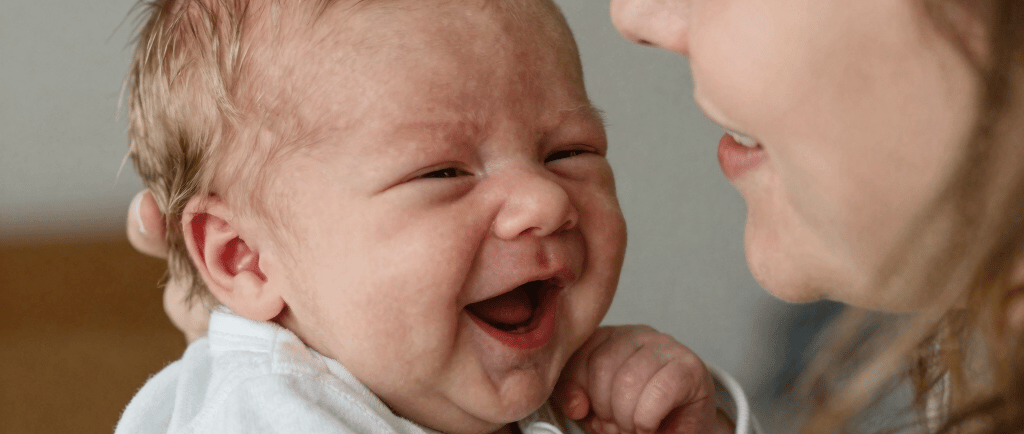
Your baby looks at you and smiles.
Not a reflex. Not gas. A real, intentional, absolutely unmistakable smile — directed straight at you.
And suddenly, everything is worth it.
This moment — this single, fleeting moment — is why parents lose their minds taking photos. Why we call everyone we know. Why we cry happy tears at 4 a.m. It's not just adorable. It's neurologically significant. And understanding why makes this milestone even more magical.
The Science: When Baby Smiles Become Real
Here's what blows most parents' minds: your newborn can't actually smile at you for the first 6-8 weeks.
Those early "smiles" in the first 2-3 weeks? That's a reflex called a "spontaneous smile" or "endogenous smile." It happens during REM sleep and has nothing to do with you. Your baby is literally just... smiling in their sleep.
It sounds crushing, but here's where it gets beautiful.
Around 6-8 weeks, everything changes. Your baby's prefrontal cortex (the part of the brain responsible for social bonding and intentional behavior) starts maturing. This is when "social smiles" appear — smiles that are directed at you, that respond to your face, your voice, your presence.
A study published in Developmental Psychology found that this shift from reflex smiles to social smiles is one of the first true signs of emotional bonding. Your baby isn't just recognizing you — they're choosing to smile at you. They're expressing joy in response to your presence.
That's not just cute. That's attachment happening in real time.
What's Happening in Baby's Brain
When your baby smiles at you, a cascade of neurological events is occurring:
Recognition — Baby's brain identifies you as a familiar, safe person
Emotional processing — The limbic system (emotion center) activates
Motor control — The facial muscles contract intentionally
Social bonding — Oxytocin (the "love hormone") is released in both of you
Yes, you're also experiencing a neurological response. When you see your baby smile, your brain releases dopamine and oxytocin. That rush of joy? That's not just emotion — it's chemistry. It's bonding at the molecular level.
The research is clear: These early social smiles create neural pathways in your baby's brain associated with safety, trust, and secure attachment. Every smile they give you is literally building their capacity for healthy relationships.
The Timeline: When to Expect Those Game-Changing Smiles
Weeks 0-2: Reflex Smiles (During Sleep)
Involuntary, usually during REM sleep
Completely unrelated to you
Adorable, but not "social"
Weeks 3-6: The Waiting Game
Baby is getting closer to social smiles
Watch for prolonged eye contact
Your baby is building recognition
Weeks 6-8: The First Real Smile 🎉
This is it. The real deal.
Happens when baby is awake and looking at you
Often accompanied by cooing or babbling
Your entire world shifts
Weeks 8-12: Social Smiles Become Regular
Baby smiles in response to your voice
Smiles at other familiar faces
Starting to anticipate interactions
Pro tip: Not all babies smile on the same timeline. Some smile at 5 weeks, some at 10 weeks. Both are completely normal. Don't compare your baby's smile timeline to anyone else's.
Why This Moment Matters So Much (Besides the Obvious)
That first real smile isn't just a cute milestone. It's significant for your baby's development:
For attachment: Social smiling is one of the first markers of secure attachment. It shows your baby feels safe with you.
For communication: Smiling is your baby's first intentional social signal. It's the foundation of all future communication.
For brain development: Every smile triggers neural connections related to emotional regulation, social understanding, and trust.
For your mental health: If you're struggling with postpartum depression or anxiety, that smile can be a turning point. Research shows that responsive smiling interactions significantly improve parental mood and reduce depression symptoms.
The Products That Capture the Magic
Once your baby starts smiling, you'll want to document it. Here are the essentials:
Instax Instant Camera — Print photos instantly. There's something magical about holding a physical photo of that first smile within seconds.
Baby Milestone Book — Document each smile and giggle. Write down the date, time, what made them smile. These details matter more than you think.
Leather Baby Album — Preserve these moments beautifully. Years from now, you'll flip through and remember exactly how that first smile felt.
Bonus tip: Don't just photograph the smile — record a 10-second video. The cooing sounds, the eye contact, the full-body joy of a smiling baby — you won't get those from a still photo.
The Emotional Reality
Can we talk about something that nobody warns you about?
That first smile is also bittersweet.
Because the moment it happens, you realize how fast time is passing. You realize your tiny newborn is becoming a person — a person with preferences, with personality, with the capacity to choose you. And suddenly, the sleepless nights and the overwhelm don't feel quite as heavy, but they also feel more poignant.
You start taking more photos. You start being more present. You start noticing everything, knowing it won't last.
And that's okay. That bittersweet joy is part of parenting. It means you're present. It means you understand how precious this is.
The Bigger Picture
Your baby's first smile is just the beginning.
Over the next months and years, you'll see:
The giggle (around 3-4 months)
The laugh (5-6 months)
The smile-that-shows-they-understand-a-joke (12+ months)
Each one is a milestone. Each one shows brain development, personality emerging, connection deepening.
But that first smile? That's the one you'll remember forever. That's the moment you truly felt the bond. That's when your baby stopped being this mysterious creature and became your baby — the one who smiles at you.
Sources: Developmental Psychology Journal, Attachment Theory (Bowlby & Ainsworth), Research on Parental Depression and Infant Smiles, AAP Developmental Milestones
This post is informational. Every baby develops at their own pace — if you have concerns about your baby's development, always consult your pediatrician.
hello@mybabysteps.online
© 2025. All rights reserved.